
The Number That’s Been Lying to You for Years
Your analytics dashboard has a metric that looks simple and trustworthy. Bounce rate. One number. Easy to understand. If it’s high, something is wrong. If it’s low, something is right.
That number is lying to you. Not a little. A lot. And the lie is getting worse.
Bounce rate measures the percentage of visitors who view a single page and leave without further interaction. Google Analytics defines it precisely: a session with exactly one hit. One pageview. No events. No additional page loads. That’s a bounce.
Traditional marketing wisdom treats every bounce as a failure. The visitor came, looked, and rejected you. High bounce rate means bad content, bad design, or bad targeting. The prescription is always the same: more engaging content, stronger calls to action, better user experience.
That prescription assumes the visitor came to explore. For twenty years, that was a reasonable assumption. It’s not anymore.
The Visitor Who Came, Saw, and Got What They Needed
Consider a specific visitor. A operations director at a logistics company asks ChatGPT about warehouse management systems. The AI recommends three options and provides specific details about each, including pricing ranges and implementation timelines. The director clicks through to your pricing page, confirms the price fits their budget, and leaves.
They accomplished exactly what they came for. They validated a specific data point. Your site delivered it. The visit was a success for both parties.
Google Analytics records it as a bounce. Your marketing team sees a 70% bounce rate on the pricing page and flags it as a problem. Someone writes a memo about “pricing page optimization” and the cycle continues.
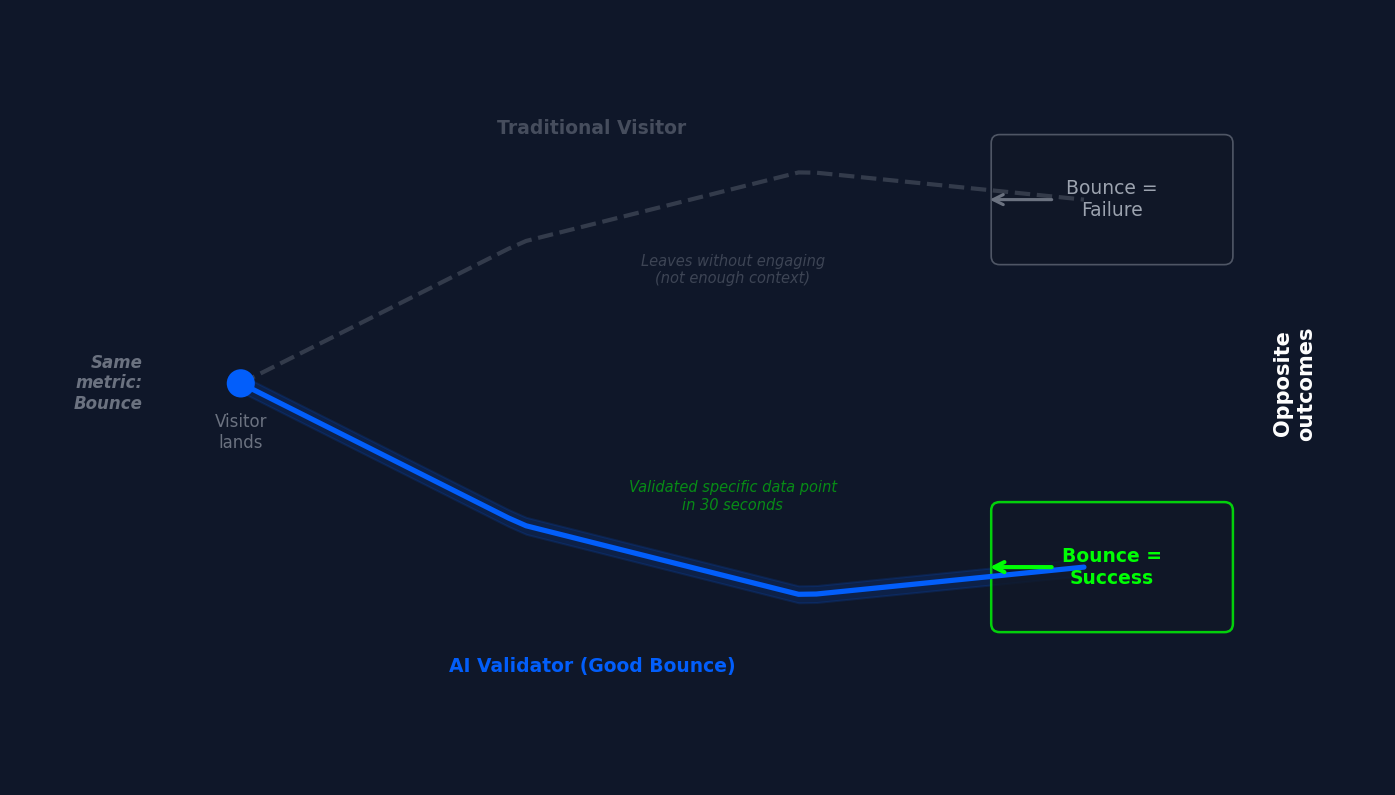
We call this a Good Bounce. The visitor landed, instantly validated a specific data point, and left satisfied. Traditional analytics count it as a failure. But treating it as a failure leads to exactly the wrong fixes. You start adding calls to action to a page where the visitor didn’t need one. You start redesigning a layout that worked fine. You create problems while trying to solve one that doesn’t exist.
Why This Is Getting Worse, Not Better
The proportion of Good Bounces in your analytics is growing because the proportion of AI-referred visitors is growing.
AI systems do something that traditional search didn’t: they provide detailed answers before the click. When someone Googles “warehouse management system pricing” and clicks your result, they’re arriving with minimal context. They need to explore. When someone asks ChatGPT the same question and clicks through, they already know your approximate pricing, your key features, and how you compare to competitors. They’re arriving to confirm, not discover.
Validators confirm fast. They land, find the one or two things they need to verify, and leave. That’s efficient. That’s a successful visit. Your analytics just can’t tell the difference between a Validator who got what they needed and an Explorer who gave up.
The consequence is that your bounce rate is becoming a less accurate measure of site performance over time. A site with strong AI referral traffic will show a rising bounce rate even if the site is performing well for those visitors. The metric is broken for the new Intent Signature.
What to Measure Instead
Traditional analytics gives you two signals per visit: pages viewed and time on site. Neither is sufficient for AI-shaped visitors. A Validator might view one page for eight seconds and leave completely satisfied. An Explorer might view five pages for four minutes and leave frustrated. The first visit scores worse on every traditional metric and was actually the better outcome.
You need different questions. Not “how many pages did they see?” but “did they find what they came to validate?” Not “how long did they stay?” but “how quickly did they get their answer?”
Validation speed is the metric that matters for AI-shaped visitors. Time from landing to finding the specific proof they came to verify. If that number is under ten seconds, the visit was probably successful regardless of what the bounce rate says. If that number is over sixty seconds, something is wrong even if they viewed four pages.
The practical way to track this is intent-aware analytics. Tag your AI referral traffic separately. Within that segment, track specific engagement events that indicate successful validation: scrolling to a pricing section, downloading a spec sheet, viewing a case study. These are micro-conversions that traditional bounce rate doesn’t capture.
The Real Bounce Rate Problem
There are, of course, real bounces. Visitors who land and leave because the site didn’t deliver what they needed. Those exist and they matter. The problem is that your current analytics merges real bounces with Good Bounces into a single number that tells you nothing useful about either.
Separating the two requires knowing where the visitor came from and what they were likely trying to do. AI referral traffic with a short session and a specific page view (pricing, specs, a named feature page) is likely a Good Bounce. Direct traffic with a short session on your homepage might be a real bounce. The context determines the interpretation.
Without that context, you’re optimizing blind. You might be adding friction to a page that works, or ignoring a page that’s genuinely failing because its bounce rate looks acceptable when diluted by Good Bounces.
The Implication
If you’re making site decisions based on bounce rate without separating Good Bounces from real bounces, you’re making decisions on bad data. The “problem” you’re fixing might not exist. The real problem might be hidden in a number that looks fine.
Traditional web analytics were built for the Explorer era. AI-shaped visitors need a different measurement framework. If you don’t build one, your analytics will tell you your site is failing when it’s actually succeeding, and succeeding when it’s actually failing.
The bounce rate isn’t just lying to you. It’s directing your optimization efforts toward the wrong problems.
[Your bounce rate is one number. Your AI-shaped visitors need a better one. Corlarity builds measurement frameworks that tell you what is actually happening on your site. Let’s find it.]




Find Out What AI Tells Buyers About You
An AI visits your site and reports everything it found. Scored across six categories with machine-verifiable findings. No cost, no pitch.
Get Your Free Snapshot